¶ Overview
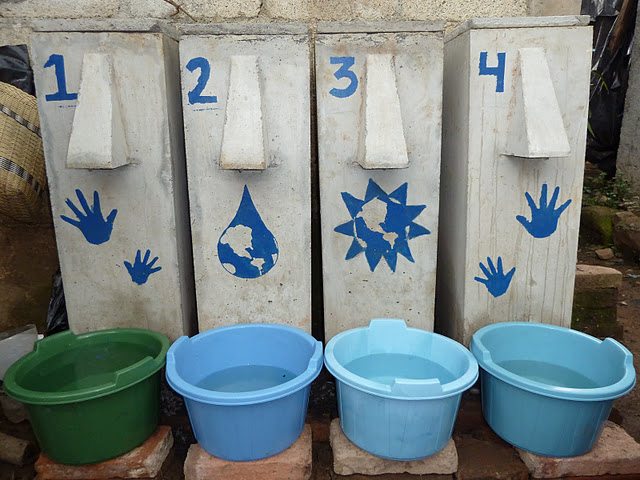 Biosand Filters in Guatemala
¶ Processing Target
The target of biosand filtration is to provide safe drinking water by removing impurities, including suspended solids, turbidity, bacteria, viruses, and parasites, from the water. Biosand filtration can remove up to 99% of these impurities, making it an effective and low-cost option for improving water quality in rural and low-income communities.
¶ Application
The application of biosand filtration is straightforward and does not require electricity, chemicals, or complicated equipment. Water is poured into the top of the filter and slowly drips through the sand and gravel layers, where it is cleaned by the microbial biofilm. The filtered water is then collected in a container at the bottom of the filter.
¶ Limitations
The limitations of biosand filtration include the need for regular maintenance to ensure the filter remains effective, including cleaning the sand and gravel layers and periodically replacing the biofilm. Additionally, biosand filters may not be effective at removing certain contaminants, such as heavy metals and some chemicals. The effectiveness of the filter can also be impacted by factors such as the quality of the source water, the amount of water flowing through the filter, and the age and condition of the filter itself.
¶ Usage
More information can be found on the official CAWST website to Biosand Filtration.
 Schematic of a Biosand Filter
- Use the best quality water you can in the filter. The water should be the cleanest available since the filter is not able to remove 100% of the pathogens and turbidity (dirtiness or cloudiness). If the source water is very contaminated, the filtered water may still have some contaminants.
- Use clear water. The turbidity of the source water is also a key factor in the operation of the filter. Higher turbidity levels will plug the filtration sand layer more quickly. In this case, the user will need to do maintenance more often to maintain a convenient flow rate. If the source water is over 50 NTU, it is recommended to use a sedimentation method before pouring the water into the filter. A simple test to measure the turbidity is to use a 2 litre clear, plastic bottle filled with the source water. Place this on top of a paper with large letters on it. If you can see the letters looking down through the top of the bottle, the water probably has a turbidity of less than 50 NTU.
- Do not pour water that has been chlorinated into the filter. The chlorine will kill the biolayer.
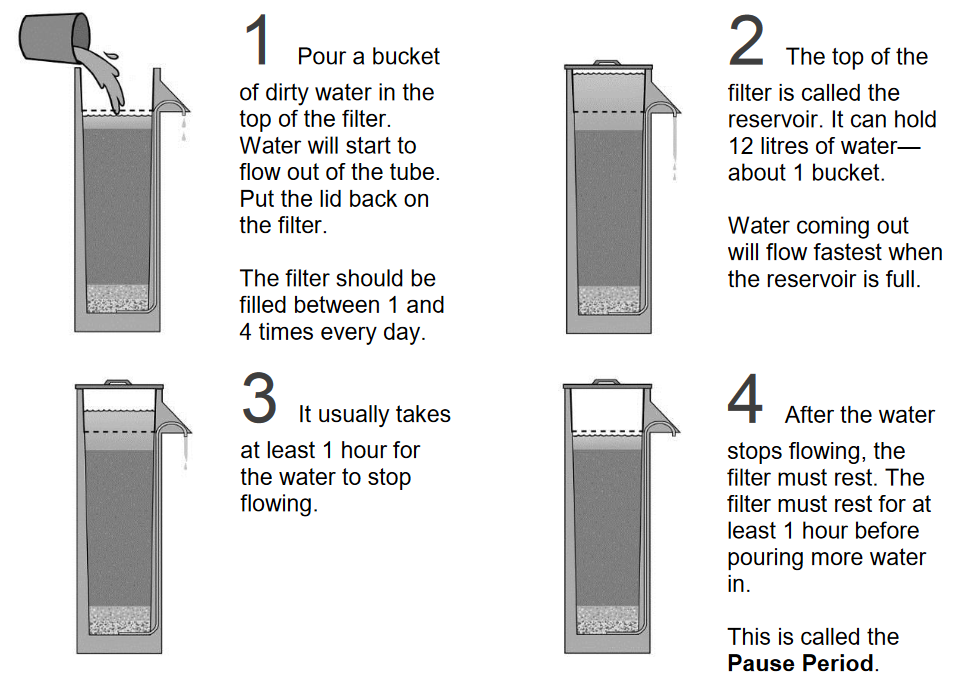 Usage of a Biosand Filter
¶ Modifications
Biosand filters can be upgraded with various modifications to eliminate additional contaminants from the water.
¶ Arsenic Removal
The modification of a biosand filter with nails can be an effective method for removing arsenic from water. Nails provide a source of iron that can react with the arsenic in the water, forming iron arsenate, which is insoluble and can be removed by the filter.
To modify the biosand filter, iron nails should be placed in a layer at the top of the filter bed. It is recommended to insert the nails on a tray or other container to keep them in place. It is important to note that this modification may not be effective at removing other contaminants, and regular maintenance and replacement of the iron nails may be necessary to ensure continued effectiveness.
While the modification of a biosand filter with iron nails can be a low-cost and effective method for removing arsenic from water, it is important to ensure that the filter is properly constructed and maintained to ensure safe and effective water treatment. It is also important to regularly test the filtered water for arsenic (and other contaminants) to ensure that the filter is functioning properly.